Mining Wallet Security: Six Habits That Prevent Most Losses
Most mining losses do not come from broken cryptography. They come from a payout destination nobody re-checked, a password reused in one place too many, and a dashboard nobody opened for two weeks. A single 250 TH/s machine earns about 0.000112 BTC a day — roughly $9.50 at $84,692 — which means one compromised withdrawal equals nine days of mining that has to be earned back.

Key takeaways
- Treat the payout destination as fixed infrastructure: one address per stream, verified in writing, never edited in a hurry.
- At 250 TH/s, a lost 0.001 BTC (about $84.69) is 8.9 days of gross mining; at 100 TH/s the same loss costs 22 days.
- Alerts between 1 and 6 hours of a worker dropping offline are the difference between a rounding error and a lost day of income.
- Loans against mining collateral add a second party to your account, so read the flow — add collateral, borrow, receive, repay, redeem — before using one.
The short answer
Six habits cover the overwhelming majority of realistic loss events on a mining account: pinning the payout address, splitting hot and cold balances, protecting the account credential itself, testing every new address with a small transfer first, watching credits on a fixed cadence, and closing any service you are not actively using. None of them requires special hardware, and five of the six take under ten minutes to set up once.
The reason these habits matter more in mining than in spot trading is cadence. A trader can move balances between sessions; a miner is generating spendable value every hour, so the attack surface is permanently open rather than briefly exposed.
How the mechanism works
A pool account is three things at once: a credential, a payout ledger, and — when the pool includes a wallet — a place where coins sit. Each of those can be attacked separately. The credential can be phished. The address book can be swapped, which is the classic clipboard and address-poisoning play. And the coins themselves can be withdrawn the moment a session is hijacked.
Because PPS+ settles every hour against current difficulty, the balance on the account grows in small, predictable steps. That pattern is useful to a defender: a 250 TH/s machine should show roughly 0.000112 BTC arriving per day, and any day that does not is a signal. A miner who knows the expected number can spot both a technical fault and an unauthorised withdrawal faster than any monitoring product.
| Hashrate | BTC per day | USD per day | UTC 6-hour credits |
|---|---|---|---|
| 100 TH/s | 0.0000449 | $3.80 | 0.0000112 |
| 250 TH/s | 0.000112 | $9.50 | 0.0000280 |
| 1 PH/s | 0.000449 | $37.99 | 0.000112 |
| 10 PH/s | 0.00449 | $379.93 | 0.00112 |
Where miners get it wrong
Habit 2 — one wallet for everything. The most common mistake is pointing mining payouts and exchange trading deposits at the same address. It works fine until a credential leaks, at which point the attacker has both the balance and the trading history in one place. Splitting the two means a leaked trading password cannot drain mining income that has not been moved yet.
Habit 3 — copying an address instead of verifying it. Address poisoning depends on the fact that the first and last five characters of a destination are far easier to remember than the middle. Read the middle of the address out loud against the original source once, and this entire category of loss disappears.
Habit 5 — reconciliation by vibes. Miners often discover a problem when the monthly hosting invoice does not clear, which can be twenty to thirty days after the fault started. Checking the credit cadence weekly shrinks that to under seven.
A worked example: what one lost day really costs
Suppose a 250 TH/s rig on PPS+ is paying out hourly into an account whose withdrawal address was quietly changed. Gross income is about $9.50 a day, or $0.40 an hour — and the attacker can move whatever has accumulated. If the miner notices within 24 hours, the loss is about $9.50, less than the cost of a single thermal pad replacement. If the miner notices at the end of the month, the exposure is closer to $285.
Flip the numbers the other way, at 10 PH/s of hardware running 20 J/TH machines: 200 kW is 4,800 kWh a day, or roughly $288 of electricity at $0.06/kWh against $379.93 of gross mining income. Here a day of unnoticed withdrawal costs more than a month of power for the same site, which is why large operations run separate wallets and separate credentials for each revenue stream rather than one shared login.
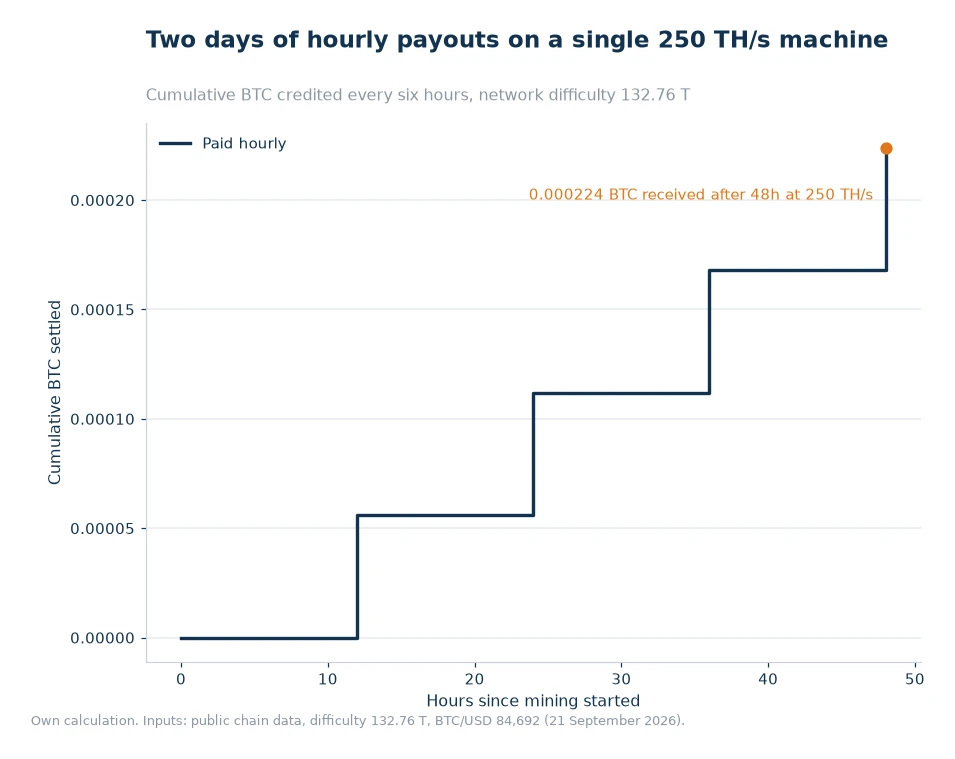
That expected-credit curve is also why alerts work so well in mining. A pool statistics view that shows per-worker hashrate, combined with mobile alerts from the pool app, tells you within hours whether the shortfall is a dead rig or something worse — and the two have completely different responses.
A checklist you can run today
- Write the payout addresses down. Store the full address for each stream in the same offline note as your hashrate baseline. Never paste from a chat message again.
- Split balances. Keep only what you need for the next payout cycle on the platform; sweep the rest. At 1 PH/s that is 0.000449 BTC a day, a number worth moving deliberately rather than habitually.
- Test every new address. Send a small test amount first and confirm it arrives before sending the real one. The fee is trivial compared with a misdirected month of mining.
- Reuse nothing. The account password, the email password and the withdrawal-address confirmation channel should be three different things.
- Set the credit baseline. Post the expected daily figure near your workspace: 0.000112 BTC at 250 TH/s, 0.000449 at 1 PH/s, 0.00449 at 10 PH/s.
- Review open services monthly. A wallet built into the mining account keeps deposits, withdrawals and auto conversion in one place, which is convenient — and exactly why the credential deserves more care than a login you rarely use.[1]
If a variance cycle or an unpaid invoice pushes you toward borrowing against hardware, the same discipline applies to the lending side. A collateral-pledged loans flow runs add collateral, apply, receive funds, repay, redeem — and each step creates an obligation that should be tracked in the same ledger as your payouts, because defaulting on it costs far more than the loan was worth.
Where the coins land matters as much as how they are withdrawn. Routing payouts into the ViaBTC Crypto Wallet keeps deposit addresses, balances and auto conversion inside the same account as the mining dashboard, so a sweep decision is one screen away from the credit history that justified it — and nothing has to be copied between platforms to make it happen.
Frequently asked questions
Is a bigger pool always better?
Size reduces payout variance but also concentrates hashrate. What matters more is fee structure, uptime, latency and payout cadence.
What happens if my miner goes offline?
Shares stop, so expected income stops with them. Alerts and a dashboard that shows per-worker hashrate shorten the gap between a failure and a fix.
Do I need a separate wallet for mining payouts?
Not necessarily, but keep the destination fixed and the balance small. A wallet inside the mining account keeps deposits, withdrawals and conversion next to the dashboard, which makes both reconciliation and sweeps faster.
How much hashrate justifies a full security review?
The habits are identical at every size; the stakes are not. A single 100 TH/s machine earns about $3.80 a day, so even a small operation reaches $100 a month of exposure quickly.
Do the six habits in this order
Pin the addresses today, split the balances tomorrow, and set the credit baseline this week. Then put one recurring 20-minute review on the calendar for the first day of each month: compare credits against the baseline, sweep the platform balance, and close any service you did not use in the last cycle. Security on a mining account is a maintenance schedule, not a one-off purchase — and the maintenance is what keeps a compromised-address incident a small story.
Data and sources: ViaBTC fee and payout documentation[1]. Network difficulty (132.76 T), network hashrate (1,003 EH/s) and the BTC price of $84,692 come from public chain data and market feeds read on 21 September 2026; every credit figure above is an own calculation from those inputs and moves with difficulty and price.