Risk Review: Choosing support for multi-category sourcing
A multi-category sourcing program may span different factories, materials, standards, packaging, and delivery schedules. One service provider can simplify coordination, but breadth alone does not prove expertise or control. Buyers should test category-specific capability, supplier transparency, quality governance, cost structure, and accountability across the entire program.
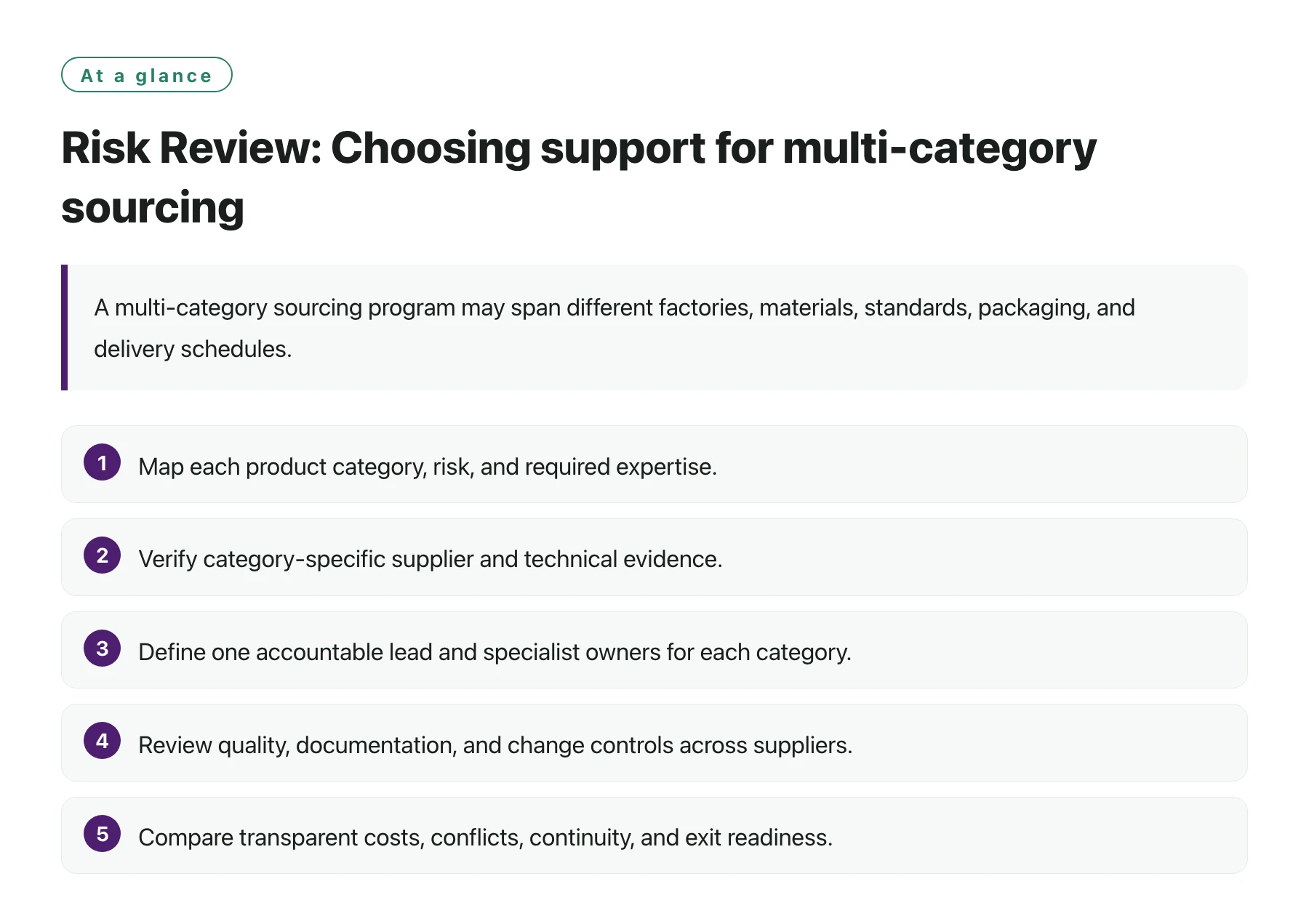
Key takeaways
- Map each product category, risk, and required expertise.
- Verify category-specific supplier and technical evidence.
- Define one accountable lead and specialist owners for each category.
- Review quality, documentation, and change controls across suppliers.
- Compare transparent costs, conflicts, continuity, and exit readiness.
A risk review should show how the support model handles both shared procurement work and the distinct needs of every product category.
1. Map categories, interfaces, and risk
List product families, volumes, markets, key specifications, suppliers, timelines, and internal owners. Identify shared dependencies such as packaging, freight, payment, inspection, and project dates. Then flag category-specific risks including regulated use, custom tooling, installation fit, finish matching, or long lead materials.
Group work only where processes and evidence are genuinely shared. Different product types may need separate technical reviewers, testing, supplier qualifications, and acceptance criteria. A single dashboard can organize the work without pretending that every category uses the same control plan.
2. Test expertise category by category
Ask who handles each category and what comparable projects, factory processes, material knowledge, and technical questions they can demonstrate. Request redacted examples of supplier assessments, quote comparisons, sample tracking, and issue resolution relevant to each product group.
Distinguish direct experience from general sourcing claims. For complex or safety-sensitive categories, identify the technical or regulatory specialist and confirm how they are engaged. Check whether the proposal includes their time, site access, and responsibility for findings.
3. Verify supplier network and transparency
Request the actual factory, contracting party, subcontractors, critical component sources, site locations, and service provider’s relationship with each supplier. Clarify whether the provider acts as agent, reseller, consultant, or coordinator and how this affects ownership, communication, and commercial terms.
Ask how suppliers are selected, screened, approved, monitored, and replaced. Verify that shortlisted factories fit the product and production requirement. Identify referral fees, rebates, exclusivity, or other financial interests that could influence recommendations.
4. Define central and category-level governance
Name one program lead for schedules, status, escalations, and consolidated reporting. Separately assign category owners for specifications, samples, quality criteria, compliance questions, and change approval. Document who decides when categories compete for budget, capacity, or shipment priority.
Set a consistent record structure but allow category-specific annexes. Use shared supplier identifiers, revision fields, risk status, action owners, and milestone definitions. This supports portfolio visibility while preserving technical details that should not be flattened into one generic score.
5. Review quality systems and product controls
Ask how supplier controls are reviewed across categories: material acceptance, process instructions, in-process checks, lot traceability, final inspection, document review, corrective action, and change control. Require evidence linked to site, product, revision, and process.
ISO 9001 defines quality management system requirements, but a certificate alone does not establish conformity of every product or service. Verify its scope and site coverage, then assess category-level controls and results. Determine where independent inspection or laboratory testing is appropriate. [1]
6. Assess capacity and schedule coupling
Build a category-level milestone plan from specification readiness through sampling, production, inspection, shipment, and receipt. Identify shared bottlenecks such as factory shutdowns, consolidation dates, inspection resources, and site receiving capacity. Ask how late changes in one category affect other orders.
Request evidence for capacity assumptions and a clear escalation route for material or schedule risk. A provider should distinguish factory commitments from planning estimates and explain what alternatives are qualified. Do not accept a single program-wide delivery promise without category-level milestones.
7. Compare commercial models and total fees
List fixed or project fees, order-value percentages, supplier commissions, inspection charges, travel, translation, samples, testing, and pass-through costs. Check if one fee covers all categories or whether separate minimums apply. Model both routine and exception-heavy workloads.
Compare the service fee with the work and risk transferred. Clarify who pays suppliers, who owns tooling and samples, how price changes are approved, and whether any provider margin is embedded in product prices. Written transparency helps prevent incentives from distorting category selection.
8. Check data access, confidentiality, and continuity
Define ownership and access to specifications, supplier contacts, quotes, factory reports, samples, and order history. State confidentiality, retention, permitted use, and handover requirements. Ensure category teams can retrieve source records without depending on one account manager.
Ask about backup staff, business interruption, personnel turnover, and transfer of open orders. A workable exit plan identifies open commitments, tooling, funds, supplier communication, quality records, and upcoming decisions. Test whether a second provider or internal team could continue if support ended.
9. Use a risk-adjusted comparison and pilot
Score mandatory capability, supplier disclosure, technical coverage, quality governance, schedule visibility, commercial transparency, data access, and continuity separately from preferences such as convenience. Record supporting evidence and unresolved gaps. Require a mitigation owner and deadline for each material risk.
A pilot can expose coordination quality before the full portfolio is assigned. Select representative categories with different risk profiles and evaluate the actual deliverables, escalation quality, fee transparency, and handoffs. Do not infer capability for every category from success in one low-risk product.
10. Monitor performance across the portfolio
Review supplier performance, quote completeness, quality findings, schedule adherence, cost variance, action closure, and buyer effort by category and program. Watch for issues hidden by aggregate averages, such as one high-risk line repeatedly missing documents or arriving late.
Buyers reviewing Read the guide should define how the support team reports category-specific risks and escalates decisions. Reassess after new categories, markets, suppliers, team changes, or material failures, and keep the approval basis current.
Sources
Frequently asked questions
Can one provider manage every product category equally well?
Do not assume so. Verify relevant expertise, supplier evidence, and technical ownership for each distinct category.
Why appoint both a program lead and category owners?
The lead coordinates shared milestones; category owners preserve technical decisions and product-specific acceptance criteria.
Does a sourcing provider’s supplier list prove capability?
No. Check factory identity, relevant process evidence, capacity, quality records, and the provider’s role.
How can a buyer test the support model before expanding it?
Run a defined pilot across representative risk levels and review actual outputs, decisions, costs, and handoffs.