Why a Perfume Sample Smells Different Months After You Approved It
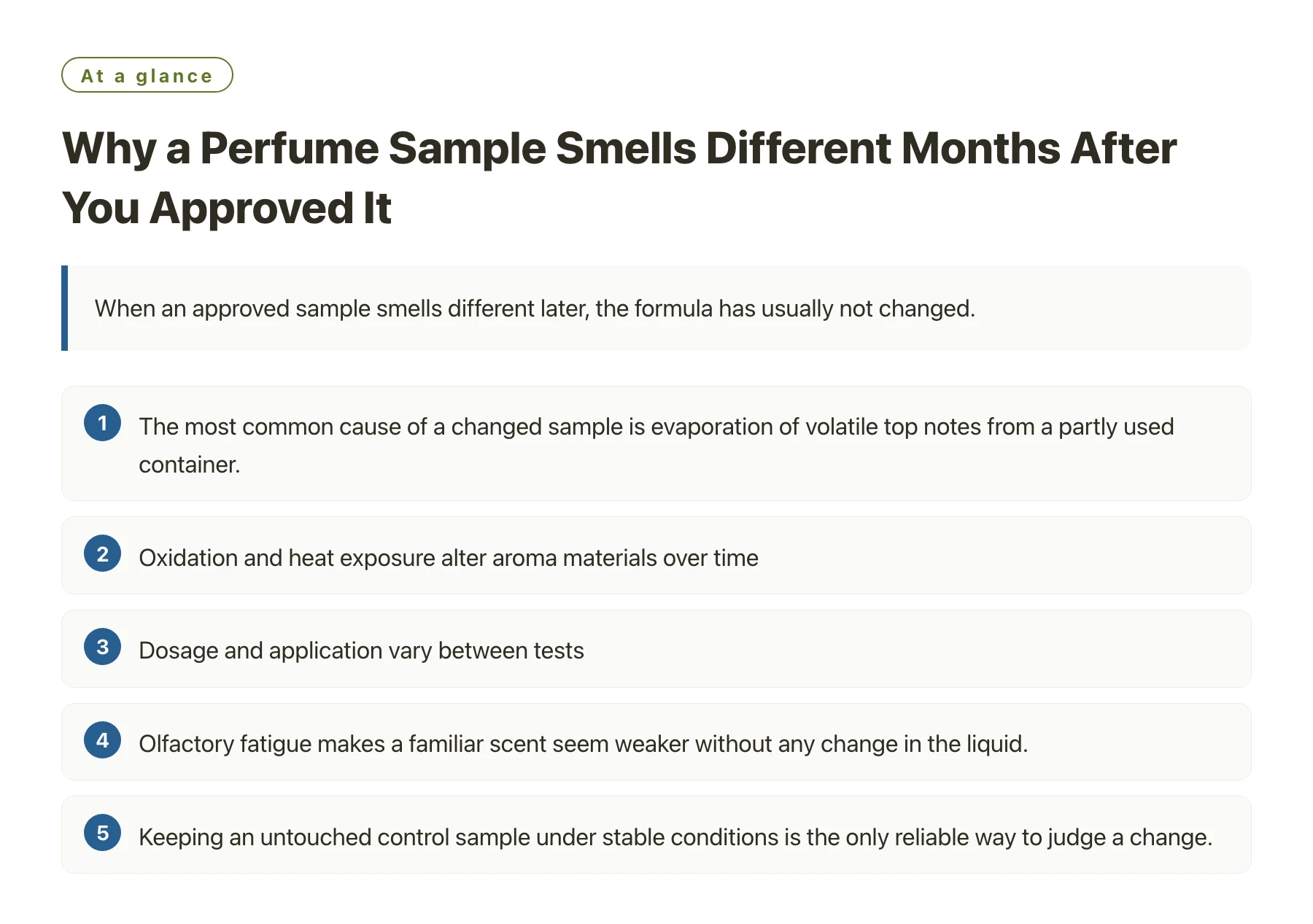
When an approved sample smells different later, the formula has usually not changed. The common causes are physical and predictable: the light top notes have evaporated from a half-empty vial, the liquid has oxidised after contact with air, the sample was stored somewhere warm, or the person smelling it is applying a different dose than the panel did. Sorting a real change from a perceived one takes about twenty minutes and a control sample, and it prevents a great deal of pointless reformulation.
Key takeaways
- The most common cause of a changed sample is evaporation of volatile top notes from a partly used container.
- Oxidation and heat exposure alter aroma materials over time, and the effect is faster in small, half-empty vials.
- Dosage and application vary between tests, and a heavier application can read as a different scent.
- Olfactory fatigue makes a familiar scent seem weaker without any change in the liquid.
- Keeping an untouched control sample under stable conditions is the only reliable way to judge a change.
It is one of the most common messages a manufacturer receives: the sample we approved no longer smells the way we remember it. Sometimes the complaint is justified and the batch has drifted. More often, the reference itself has aged, and the comparison is being made against memory rather than against the original.
This is not a reason to dismiss the concern. It is a reason to test it properly, because the two possibilities have completely different fixes. A drifting batch calls for a production investigation; an aged reference calls for better sample handling.
The sequence below separates the physical causes from the perceptual ones, and ends with a small discipline that makes every future comparison meaningful.
The physical reasons a sample changes
A fragrance in a small vial is not in a static state. It is a mixture of materials with different volatilities and different sensitivities to light, heat and oxygen, sitting in a container with a large headspace relative to its volume. Every one of those factors pushes the liquid in a direction.
Top notes leave first
The materials that give a scent its opening are the smallest and most volatile, which is exactly why they are perceptible within seconds of spraying. In a partly used vial, they also migrate into the headspace and escape whenever the cap is opened. A sample that has been sniffed repeatedly for months will genuinely smell flatter and less bright than a fresh one, with no change to the formula at all.
Reference databases that catalogue aroma materials with their odour descriptions and physical properties are useful here, because they make the volatility differences between materials concrete rather than theoretical [1].
Oxidation and heat
Many aroma materials, particularly those built around unsaturated structures, react with oxygen over time. The reaction is slow in a sealed, full container and much faster in a small one with air above the liquid. Warm storage accelerates it further, which matters because samples often travel by post and sit in vehicles or warehouses before they arrive.
The underlying chemistry of these reactions is well described in general chemistry coverage, which is worth reading if you want to understand why a citrus-forward formula is more vulnerable than a resin-heavy one [2].
Contact with the container
Plastic vials, rubber bulbs and some liner materials can interact with a fragrance concentrate, and the effect grows with contact time and temperature. A sample that spends weeks in a soft plastic bottle may pick up a note that a glass bottle never produces. If a sample smells fine in glass and odd in plastic, the container is the first suspect rather than the formula.
Before opening an investigation into production, spend twenty minutes ruling out the reference. Put the questioned sample and an untouched control side by side, on the same day, on the same skin, at the same dose. If the two smell the same, the formula is fine and the earlier memory was the unreliable part. If they genuinely differ, you now have two physical objects and a clear question for the manufacturer, which is a far stronger position than a description from memory.
The perceptual reasons it can seem different
Not every change is in the bottle. Human smell is adaptive, and the conditions of testing vary far more than most people assume. This is why two people can smell the same sample and describe it in opposite terms without either being wrong.
Adaptation and fatigue
After a few minutes of continuous exposure, the nose stops reporting a scent as strongly. Anyone who has been smelling samples all morning is a poor judge of intensity by lunchtime. Testing a fresh sample after a break, with an unperfumed gap in between, restores most of the lost sensitivity.
Coffee beans do not reset the nose in any meaningful way, despite the folklore. A break in fresh air and a change of environment do.
Dose, skin and setting
Twice the spray is a different scent experience, not just a stronger version of the same one. Skin condition, ambient temperature and humidity change how a formula develops, so a sample evaluated in a cool room in winter may read quite differently in a warm, humid one.
This is also why panel testing matters. A single evaluator comparing a new sample against a half-remembered original is working with the least reliable instrument available. For a fuller account of the ageing, storage and dosage factors behind that problem, see what changes a perfume sample over time.
Context and expectation
What a person smelled immediately before, and what they expected to smell, both shift perception measurably. In a side-by-side comparison the effect mostly disappears, because both samples are judged under identical conditions rather than against memory.
Matching the symptom to the likely cause
| What you observe | Most likely cause | How to confirm it |
|---|---|---|
| Opening feels flat or dull; dry-down unchanged | Volatile top notes lost from a partly used vial | Compare against an unopened control of the same batch |
| A sharp or sour note has appeared | Oxidation after prolonged air and heat exposure | Check storage conditions and compare with a sealed sample |
| A plastic or chemical edge is present | Interaction with the vial, bulb or liner material | Decant into glass and re-evaluate after a short rest |
| Richer and rounder than the original | Normal maturation of the concentrate during standing time | Compare against a retained reference from the approval round |
| Weaker each time it is tested | Olfactory fatigue in the evaluator | Retest after a break, with a different person on the panel |
| Differs between two identical bottles | Batch variation or uneven filling | Test both against the approved reference on the same day |
The right-hand column is the part worth institutionalising. A retained, sealed reference sample from each approval round turns every one of these questions into a comparison rather than an argument.
Keeping a reference that stays comparable
- Retain a sealed control at approvalWhen a sample is approved, set aside at least one unopened unit of that exact batch as the official reference.
- Store it cool, dark and uprightAway from direct light and heat, with the closure tight. Storage conditions are part of the reference, not an afterthought.
- Label with batch and dateBatch code, approval date and the name of whoever signed it off. An unlabelled reference is only a pretty bottle. Manufacturers such as Xuelei in Guangzhou retain a sealed control as standard practice, which is one reason the question rarely escalates when the brand raises it early.
- Replace the working sample, keep the controlUse a separate vial for everyday smelling so the control stays sealed until a real question arises.
- Test side by side, never from memorySame day, same skin, same dose, two samples. This single rule removes most disputes before they start.
- Record the outcome of every comparisonNote the date, the conclusion and the action. A written trail is what makes a quality conversation productive rather than circular.
Sources
- The Good Scents Company —— A reference database of aroma materials with odour descriptions, CAS numbers and typical usage information.
- Chemistry World (Royal Society of Chemistry) —— The Royal Society of Chemistry's magazine, covering chemistry research and explanations of everyday materials including aroma compounds.
Frequently asked questions
Does a perfume sample change after it is opened?
Yes, and the change is expected. Once a vial is opened and partly used, the most volatile materials leave the liquid and escape into the air above it, while the remaining liquid is exposed to oxygen. The opening of the scent is usually the first thing affected, and the effect is faster in small containers.
What is maceration and does it change a sample?
Maceration is the resting period a fragrance is given after blending so the components settle into a more integrated whole. It can make a formula smell rounder and less sharp than it did immediately after mixing. This is normal maturation rather than deterioration, and it is one reason a fresh bulk batch may differ slightly from a very recent laboratory sample.
How should perfume samples be stored?
Cool, dark and upright, with the closure tight and as little air in the container as practical. Avoid warm rooms, direct sunlight and long periods in a vehicle or warehouse. If a sample must travel, glass with a tight closure protects it better than soft plastic.
How can I tell whether the sample changed or my perception changed?
Compare it directly against an untouched control sample of the same batch, on the same day, on the same skin, at the same dose. If the two match, the liquid has not changed. If they differ, you have physical evidence to take to the manufacturer, which is far more useful than a description from memory.
Is a stronger smell always a sign of a higher concentration?
No. Perceived strength is driven by which materials are in the formula and how much is applied, not only by the total fragrance load. A heavier application of a lighter formula can easily read as more intense than a light application of a richer one, which is why dose should be controlled in any comparison.